The mechanic
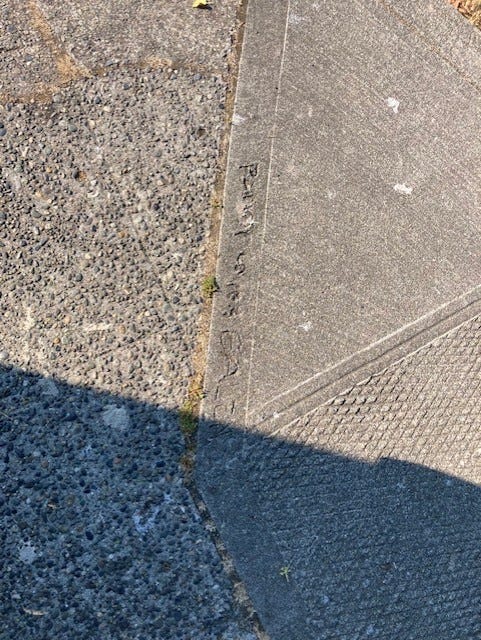
Or no one carves their name on a sidewalk anymore

He could fix just about anything, but not everything, it turns out. And maybe he tried at one time, but at some point, lost faith because there are things in this world that remain broken and incurable. I won’t ever know for sure if ever he even knew, but I suspect he did. He couldn’t fix himself.
Early mornings I would often see him, warming up his 60s-era VW bus. It would be something like five am, and I would be out for a routine walk with my dog having just crossed the big road, which we seldom do anymore because he’s old and it takes a long time to go anywhere. He would doff his hat, offer a slight wave as he made a slow, agonizing U-turn utilizing every inch of the road. Those old cars don’t have the modern-day turning radius. Then I would watch him sputtering down the street, inching ahead, motor kicking in and finally gaining momentum, disappearing in the spot where soon the sun would rise again.
His girlfriend told me he used to work on nuclear submarines, and then he worked on exotic cars, old Bugatti’s and Porsche’s, but his real passion was his art. I told her I liked seeing his work through the window, and I wanted to add how it reminded me of Miro, though me not knowing much about art would later learn Kandinsky was his favorite, especially his Bauhaus period.
He died in his sleep one night, one of those hot summer nights with record temperatures during the day swelling into the nineties and cooling a little come the night. He had been on a bender, so she had left him alone for a couple of days. COVID was tough on him, she said. He was functional, never missed work, but he struggled. He had COPD too. He smoked a lot of pot, she said, a phrasing only people from a certain generation would use.
She put some of his paintings by the side of the road, made a sign saying “free art” for the tempting eye of a passerby, and within a few hours, they were all gone. My wife picked up one of his paintings and a framed print that we thought might be one of his, but it was Kandinsky.
Every now and then I dreamed how I would be his manager, make his art available to the world so that he could experience a small, modicum of success. I didn’t really think this in a way I would ever act, and probably it was not something I wanted, but my mind wanders around and picks things up, makes a story, and goes along with it to keep me entertained. When I was younger, I wanted to have all these separate, but related businesses, all under the moniker of a parent company called Lot Thirteen. One of them was an art gallery. My only goal was that each operation would pay for itself, generate enough income to keep the doors open with people in employ.
I couldn’t settle on the name for the art gallery, not sold on Alchemy Works, but the other businesses I dreamed up all had names. The publishing company was called Souled Out Books, and the record label Thin Wild Mercurial Music. I thought there was room for a production and film company: InExile Films and Lonesome Crier Pictures. And because I wrote songs back then, I made up a music publishing company called Sad Eyed Prophet Songs, even going so far as to get an ASCAP membership.
A lot of people I knew back then were doing things, creative ventures, whether it was in a band or the arts, painting, and film. I wanted to harness that energy and create income streams for them. When I met my wife, she was a documentary filmmaker, and a darn good one, too. She even won an award at our local film festival for best documentary short, and for a while, it was available on Alaska Airlines. But it’s an impossible thing, often, to do art, to be paid to create.
He was a smart man his girlfriend said to me more than once. After the last time, I agreed with her and told her I always knew that. I always figured he was an artist/intellectual type, well-read, but withdrawn. He had that look about him like maybe the world became too much for him, or maybe he lost a sense of the point. I figured some lines from the Dylan song Not Dark Yet applied to him:
Well, my sense of humanity has gone down the drain
Behind every beautiful thing there's been some kind of pain
The chemicals and solvents knocked at least ten years off his life, she continued, talking not so much to me, but to him as if he was there, in third person for our passive observance. Up in the attic, they found hundreds more paintings. She had forgotten he had painted them. And all the same, I noted, there was a truck outside the house full of stuff, numerous paintings included, headed for the transfer station, aka the dump. She didn’t seem the least bit sad, but I cry easily, I just may not show it.
I thought of the poem by Allen Ginsberg. His famous one, the great minds of a generation destroyed by madness. And everything came back to my father, eventually. He too had squandered his life. Maybe that wasn’t the best way to put it, but he had all these talents that the world never saw. It’s a shame when people don’t come close to realizing their potential. What was it for my neighbor? For my father, obviously, Vietnam. It’s tough because we just don’t understand what happens to a person, what goes on inside of them. As much as we want to generalize, the fact remains, we are all unique, individual, and we think we have all these people around us, but in the end, we go alone.
He lived in the house on the corner. On the sidewalk, he carved his name when he was just a kid. Randy Loves Galen. A simple admission of his youth. How old would he have been? Maybe twelve or thirteen, but all the same, almost fifty years ago. Do kids today still write their names on wet concrete? I doubt it. It’s somehow too dangerous. Or something like that. I don’t know the reasons. So many things we could do when I was young, kids don’t do. Like walking to school. In grade school, as a 4th grader, I was part of patrol, which meant I escorted a group of morning kindergartners to a drop-off point and picked up the afternoon class to bring them back to the school. No adults, just another patrol member and me. The next year, I worked as a crossing guard. Again, unsupervised, stopping cars with our patrol flags so the school kids could cross the street. Today that would be considered reckless, but then again today nobody walks to school.
And so it goes, in each generation, things get lost, things get gained, and who’s to say how it all ends up? My neighbor was a rare artifact, a guy who knew how to fix things, and yes, old things, but half of the world still runs on these things you just don’t know it. My uncle fixes and programs mainframe computers. The thing is, they are written in a computer language very few people know because we’ve moved on.
Obsolescence. At some point, we all become obsolete, then they pack up all our things and throw them away. It’s exhausting and monotonous, the very phrase a reviewer concluded about my book. Seems I am already there. I get it. The only thing that’s left is a name on the sidewalk, and it’s not mine.